Your neighborhood, in one app — even when the internet goes down.
StreetSparrow is a community app for the place you actually live: a feed for your block, groups for your building or street, and private messages with your neighbors.
And when the power or the network fails, it does not go dark. Your phone quietly passes messages to other phones nearby, so the neighborhood can still talk.
Available on iOS through TestFlight. Android is on the roadmap.

StreetSparrow
Neighbors. News. Together.
Lost & found
Reunite a wandering dog in minutes
Outage-proof
Keeps working when the network fails
Private messages are encrypted end to end. What you share stays between you and your neighbors.
What you get, day to day
A genuinely useful neighborhood app first — everything else works quietly in the background.
A feed for your block
Lost dogs, a couch on the curb, the water main on Oak Street, who has a ladder. Posts stay in the area they were written in, so what you see is genuinely near you.
Groups and topics
Your building, your street, the school run, the community garden. Small spaces for the people who actually share the place with you.
Private messages
One-to-one messages, encrypted end to end. You can reach someone whose username you know, wherever they are.
Nearby first, always
Your feed is sorted by distance, so the closest and most useful things rise to the top. What you see is what your neighborhood is actually talking about.
A look inside the app
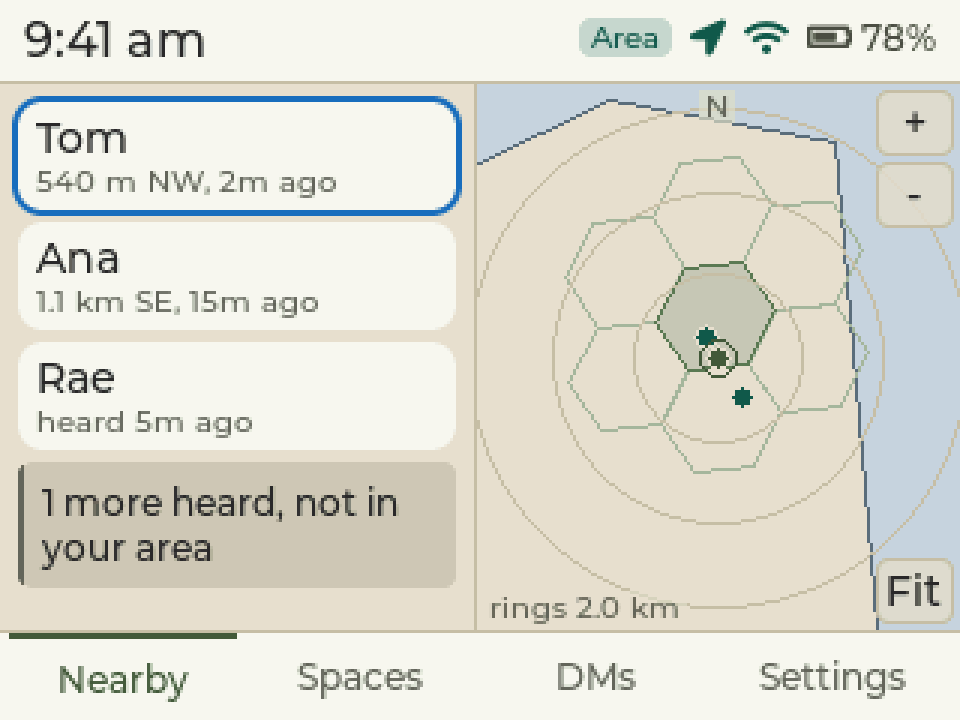
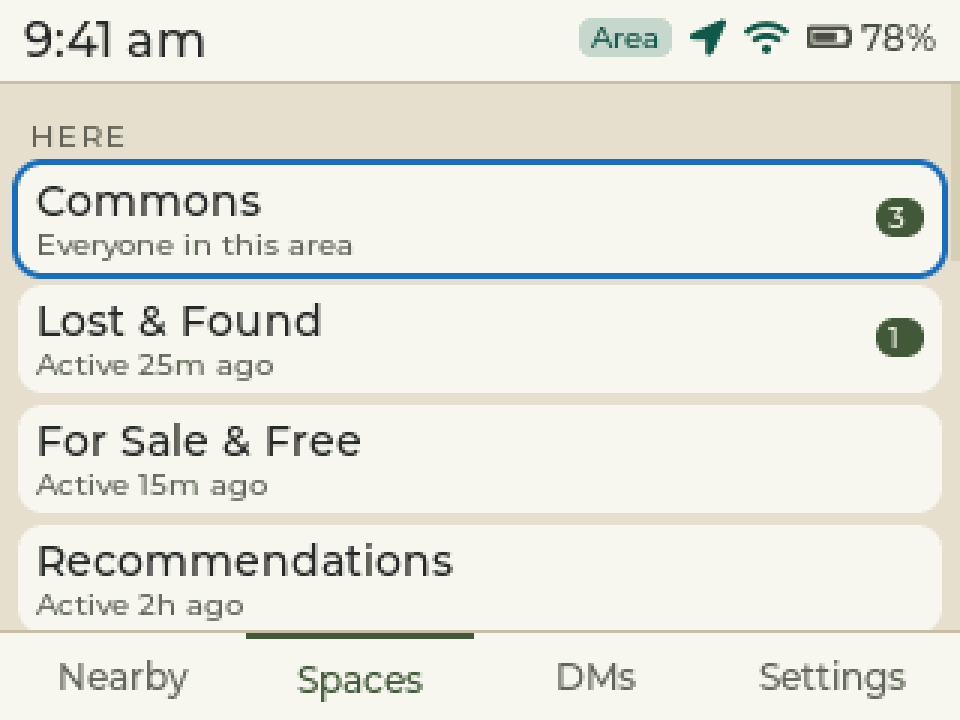
Four taps at the bottom: what's nearby, the spaces for your area, your messages, and your settings. That's the whole app.
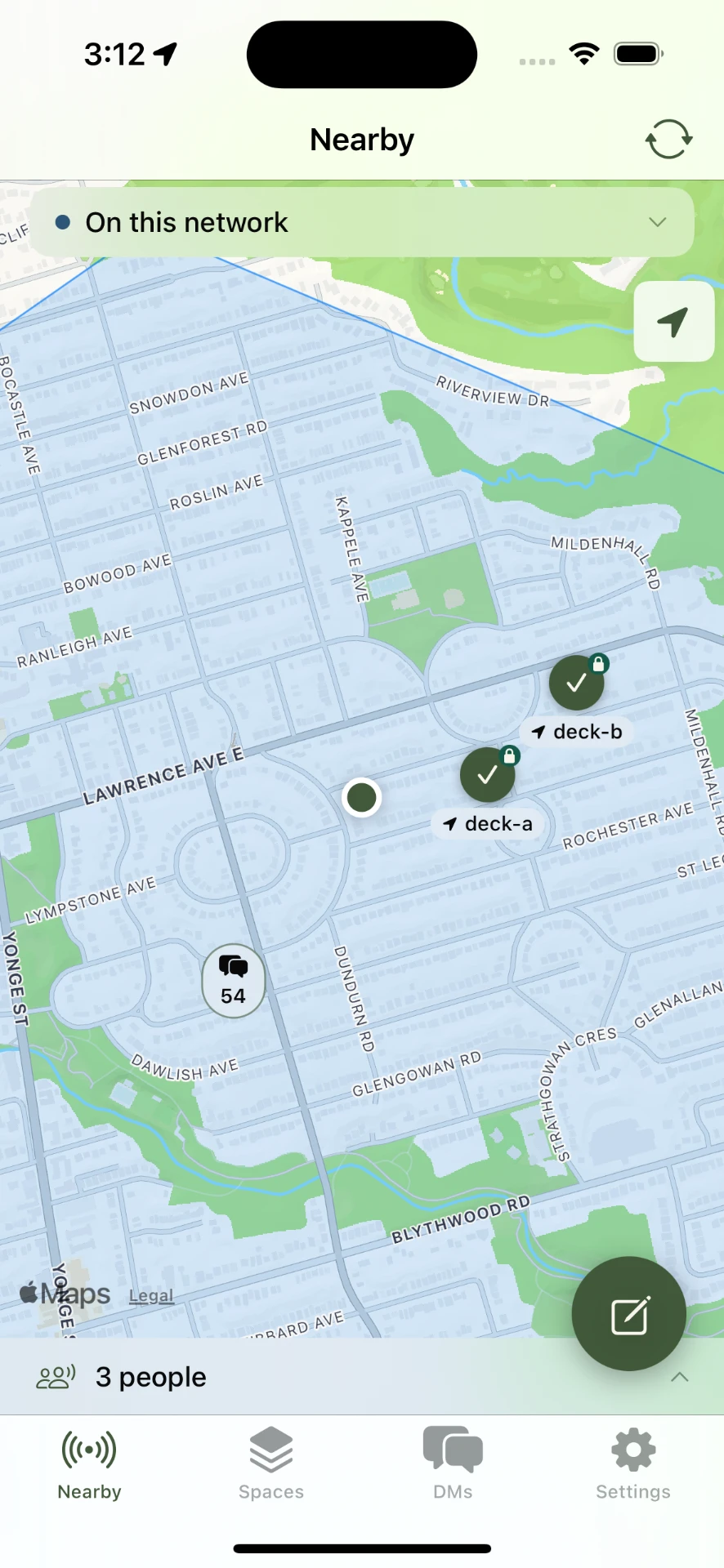
Nearby
See who and what is on your local network right now.
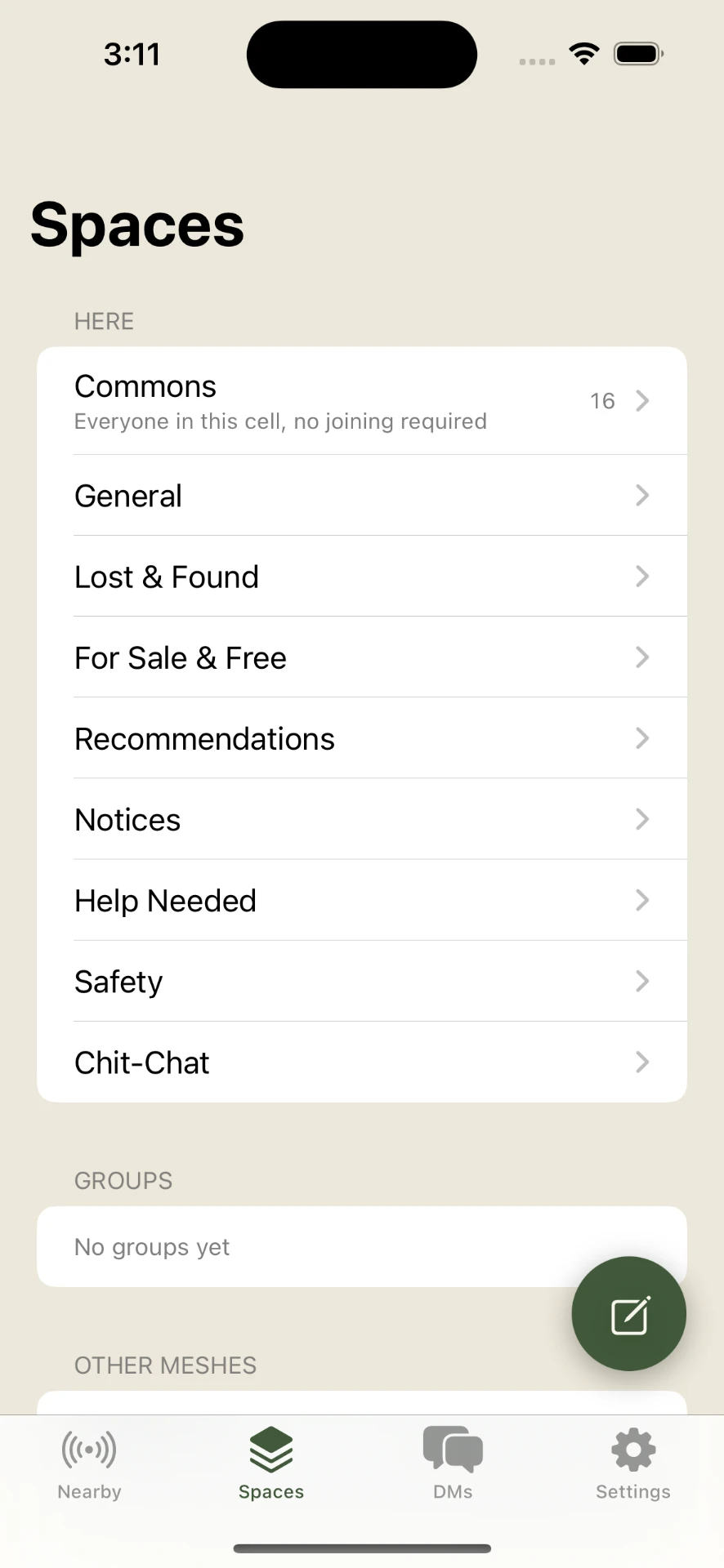
Spaces
Commons plus topic spaces for your area — no joining required.
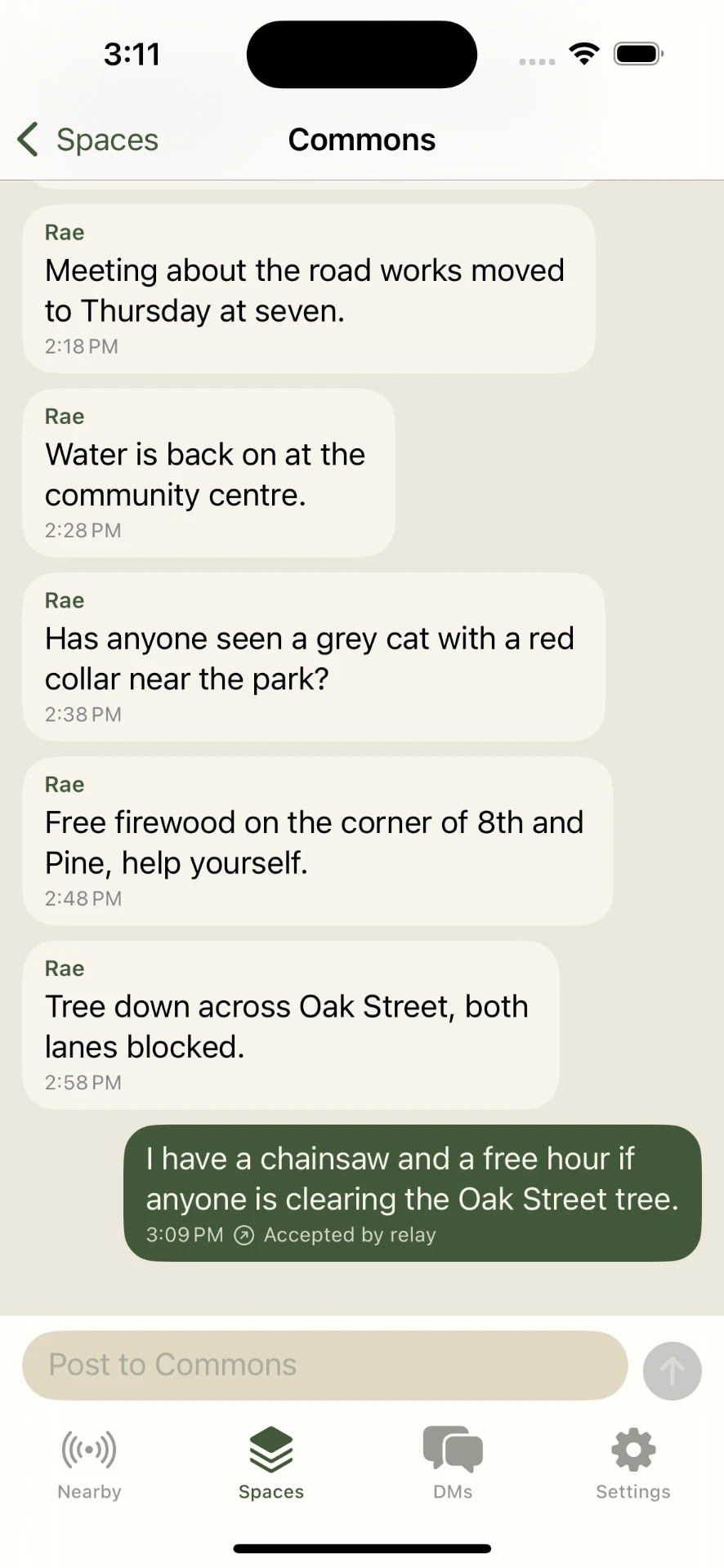
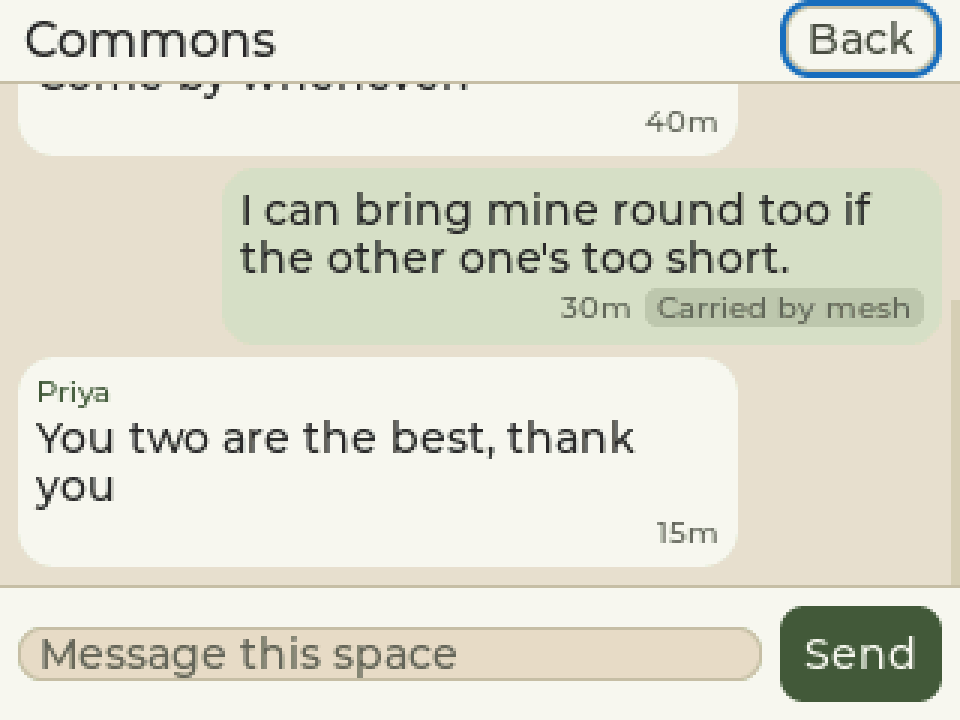
Commons
The block's conversation: road closures, free firewood, a lost cat.
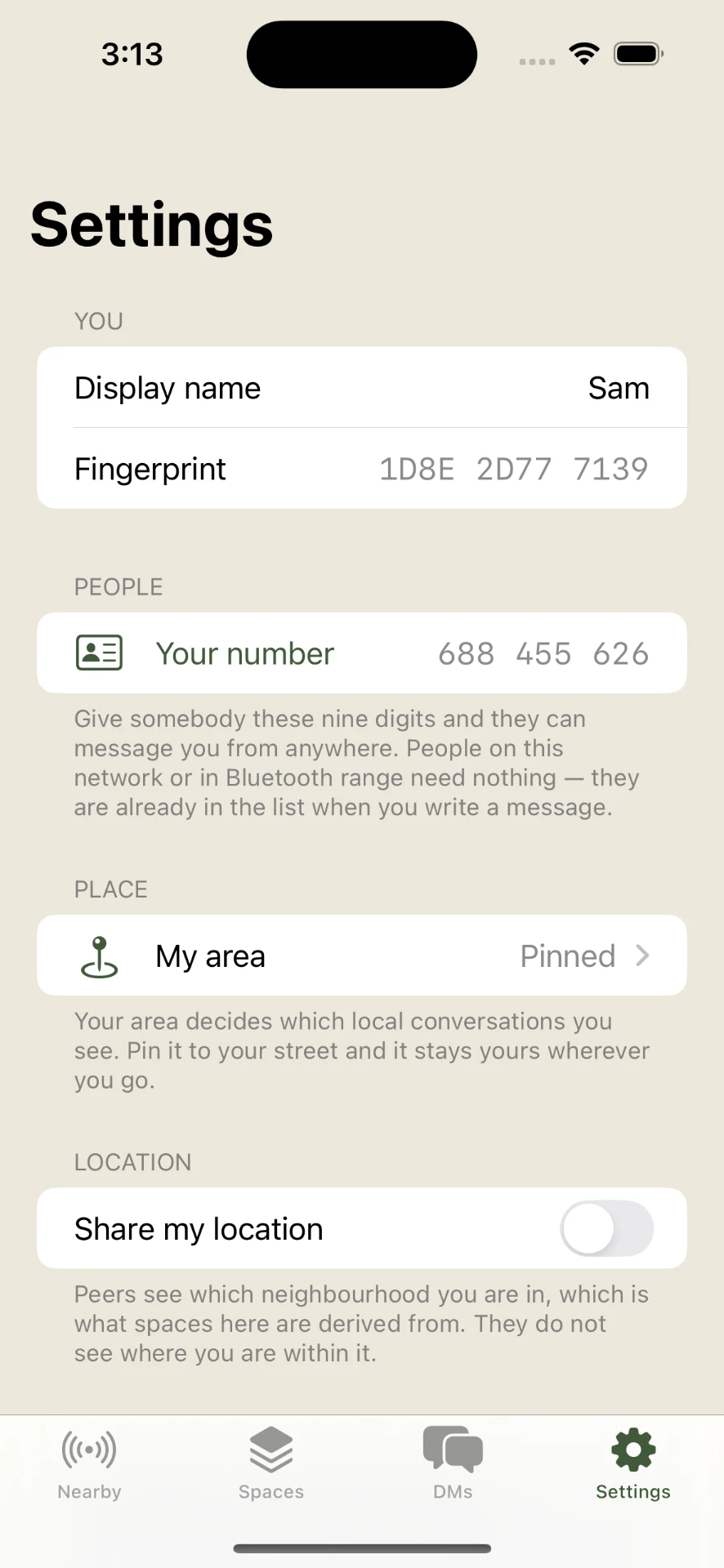
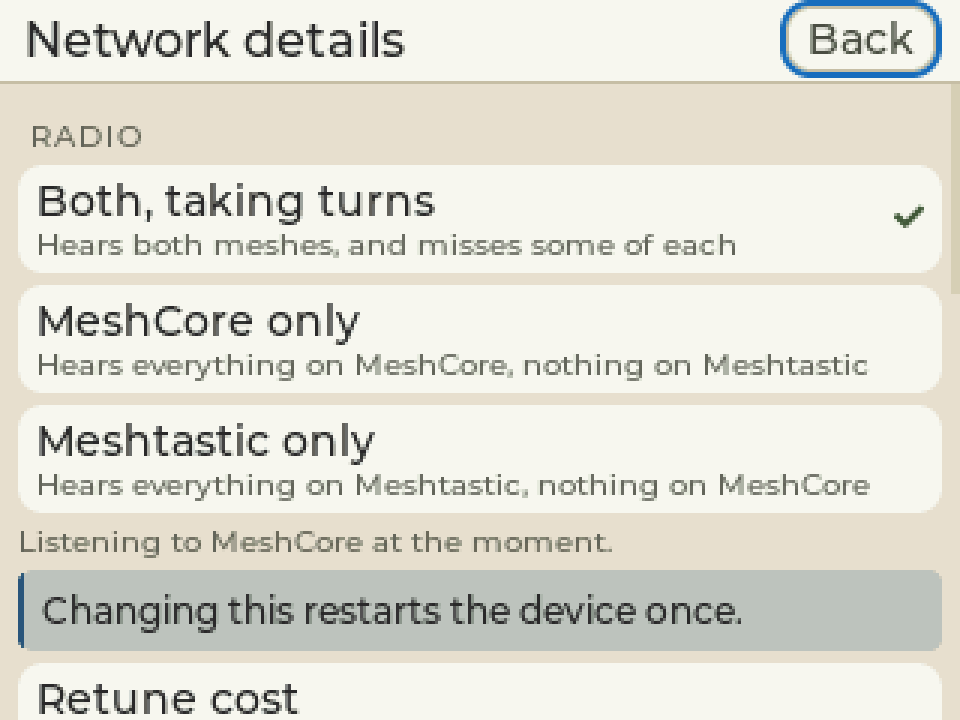
Settings
Your nine-digit number and your pinned area, in plain language.
One neighborhood, on phones and on radios.
The same spaces and the same conversations show up on an iPhone, an Android phone, and on small handheld LoRa devices. A message written on a phone can travel over radio and arrive on a neighbor's handheld blocks away — and back again.
- Phones stay the front door. Two charged phones are all it takes to start a mesh.
- LoRa hardware extends the reach. A handheld or a solar node carries the neighborhood's messages between blocks.
- Your choice of radio. MeshCore, Meshtastic, or both taking turns — pick it in settings and the app handles the rest.
- Built for long days. Handhelds run for days on a charge and keep the mesh alive while phones rest.
The same app every day — ready on the hard ones.
StreetSparrow uses the same path every day, so the version that works in an outage is the version you already know and already have friends on. It simply keeps going when other apps go quiet.
01
Normal days
The app uses the internet like any other app. Fast, familiar, ready out of the box.
02
The internet goes out
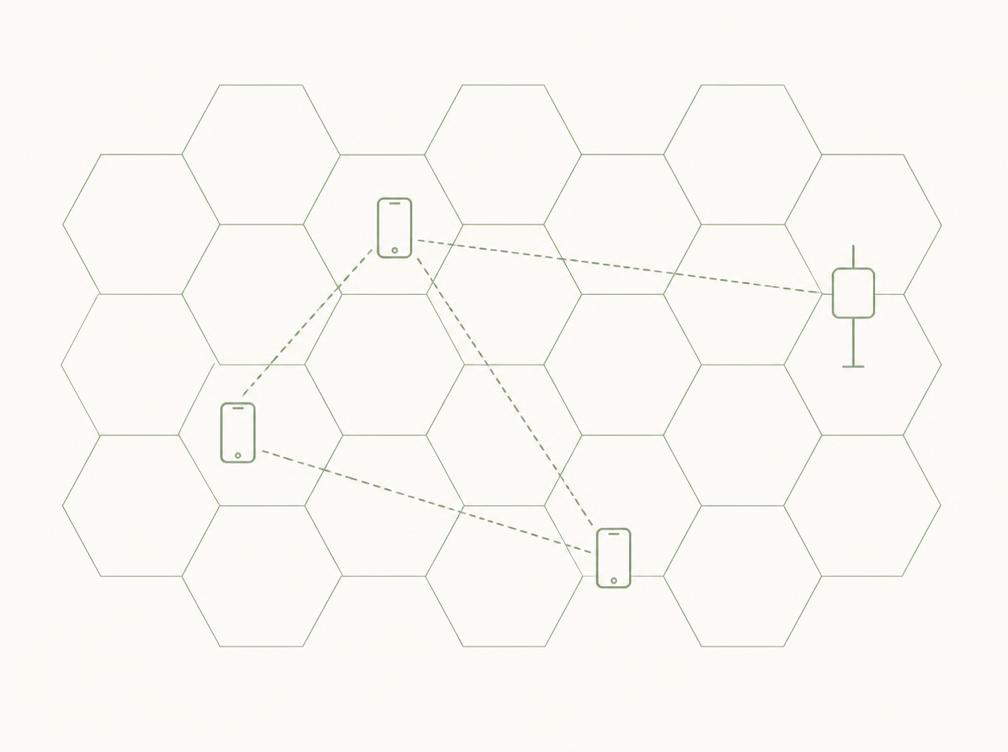
Your screen looks exactly the same. Your phone quietly starts passing the same messages directly to nearby phones over Bluetooth and Wi-Fi.
03
Days into an outage
If anyone nearby has a small radio node, messages hop between blocks — and a single reconnected phone can carry the neighborhood's mail out to the world.
In a real emergency, the messages that matter most are between neighbors. The Oak Street bridge is out. We have a generator, come charge your phone. Has anyone seen the Kowalskis?
The promise
Two charged phones are all it takes. Messages still get through.
In a real disaster, most people have a charged phone and little else, so that is the case the app is designed around. Every radio node and solar relay nearby makes it dramatically better — and two phones alone are enough.
Who it's for
One app for the whole neighborhood. What you see depends on how deep you want to go, and you can change your mind at any time.
- Residents and families
A local feed, groups, direct messages, lost pets, mutual aid, store and road status.
A friendly neighborhood app that happens to be unusually hard to knock over.
- Radio and mesh enthusiasts
Coverage walks, signal history, heard nodes, protocol paths, diagnostics.
Your existing hardware becomes first-class neighborhood infrastructure.
- Node operators and organizers
Node health, airtime, coverage, power, bridge status, drills.
Concrete, measurable neighborhood resilience you can improve.
- Businesses, institutions, authorities
Recognizable identity, status publishing, priority for genuine life-safety messages.
Recognition is granted by the local community, and priority applies to genuine life-safety updates.
Download the beta
StreetSparrow is in pre-release, and the iOS beta is open now through Apple's TestFlight. Install it, invite a neighbor, and try the same conversations on two phones side by side.
iOS beta available now. Android is coming next.
Neighborhoods
If your block, building, or school wants to try this, say so now so the pilot can be designed for a real place.
Node operators
If you already run repeaters or map coverage, your hardware is what this is designed around. Tell us what your area looks like.
Developers
Read the schemas, run the conformance vectors, and write a fourth implementation. No permission needed.
Contact details to be published.
For people who want the architecture
Everything below is optional reading. It is here because the design is the product, and anyone should be able to check it.
Four ideas
Geography is the network
Every device works out which hexagonal cell of the world it is in (H3, Uber's open grid). Those cells are the neighborhood graph. A public post is stamped with the cell it was written in and a number of geo hops it may travel, and that alone bounds who sees it — a property of geography rather than a follower graph, an algorithm, or a server's opinion.
Transports are interchangeable
Internet, Wi-Fi, Bluetooth, and LoRa radio all carry the same signed message objects under the same rules. Addressing stays identical on every transport, and a relay acts as a fast peer — identity and trust live with the sender, so losing a relay only costs reach.
Two ways to address a message
Public posts are addressed by place and stay local. Direct messages are addressed by cryptographic identity, are encrypted end to end, and can cross any distance to someone whose username you already know. The two namespaces stay separate by design. During an outage, one surviving gateway can carry the mail for a whole disconnected neighborhood while every message stays sealed.
The floor is two phones
The overwhelmingly common configuration in a disaster is people holding charged phones, so that is where the guarantee holds. Every radio and fixed node above that floor makes the network dramatically better.
Losing the internet reduces speed and capacity, while the meaning of nearby stays exactly the same. Cell distance is semantic rather than a prediction of radio range — a single LoRa transmission may jump three cells.
The capability ladder
Two phones
No power, no internet, no LoRa, no prior setup. Message exchange still happens.
A beacon
An Android phone in range gives the cluster a beacon and an on-demand Wi-Fi island.
A Sparrow Post
One battery-powered node gives the neighborhood a memory: a message left at noon reaches someone walking past at midnight.
Solar continuity
A solar node carries that memory through day seven, and more radios give the area a graph.
An intermittent gateway
A trickle to the outside world. Sealed messages leave when a path appears; nobody in between can read them.
Open by construction
62 golden conformance vectors
Any implementation must reproduce them byte for byte. The vectors are the contract.
Three independent implementations
T-Deck device firmware (C++), an iPhone client (Swift), and an internet relay (Rust), sharing no code.
Published schemas
Protobuf schemas and wire registries for the Sparrow Object Protocol (SOP). Independently implementable, royalty-free.
A cross-device test lab
Real implementations run against each other as processes and as physical radios on a desk, leaving a folder of evidence per run — including a no-path control.
A note to the mesh community
The Meshtastic and MeshCore ecosystems already provide open firmware, inexpensive radios, and people who install repeaters and map coverage. StreetSparrow turns that infrastructure into visible public value and a much larger community to serve. Existing stock users stay reachable without migrating or reflashing anything.
One transceiver time-shares between Meshtastic and MeshCore with measured, disclosed loss. Continuous dual-network infrastructure uses two radios.
Status
- ✓Protocol, schemas, and vectors published
- ✓Three implementations agreeing on the vectors
- ✓Messages exchanged over real LoRa between physical devices
- ✓TestFlight beta available
- ○Public pilot: in planning
- ○Frozen 1.0 protocol: upcoming
Licensing: reference implementations GPL-3.0-or-later (the iPhone client is MPL-2.0); schemas, registries, and conformance vectors Apache-2.0; documentation CC BY-SA 4.0.